ΕΚΘΕΣΗ ΚΥΠΡΙΑΚΟΥ ΚΕΝΤΡΟΥ ΣΤΡΑΤΗΓΙΚΩΝ ΜΕΛΕΤΩΝ
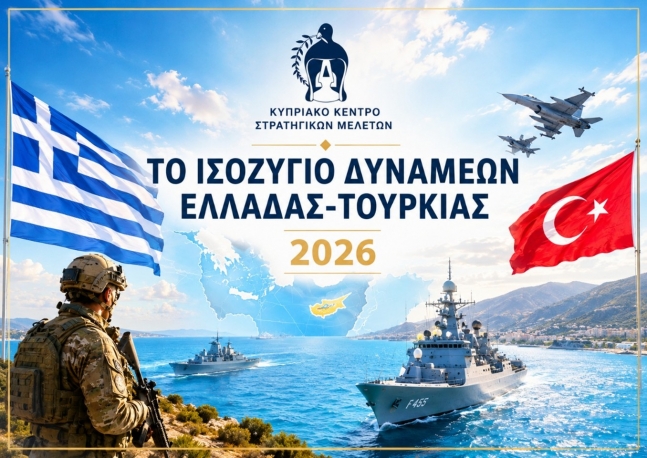
ΤΟ ΙΣΟΖΥΓΙΟ ΔΥΝΑΜΕΩΝ
ΕΛΛΑΔΑΣ – ΤΟΥΡΚΙΑΣ 2026
ΚΑΙ ΑΜΟΙΒΑΙΑ ΣΥΜΒΑΤΙΚΗ ΑΠΟΤΡΟΠΗ
Δρ Άριστος Αριστοτέλους
ΓΕΝΙΚΑ ΣΥΜΠΕΡΑΣΜΑΤΑ – ΔΙΑΠΙΣΤΩΣΕΙΣ
Η Ελλάδα βρίσκεται το 2026 με την ισχυρότερη αποτρεπτική της ισχύ των τελευταίων δεκαετιών, χωρίς όμως να έχει εξαλειφθεί η στρατηγική πρόκληση που δημιουργεί η αριθμητική υπεροχή της Τουρκίας.
Οι Ελληνικές Ένοπλες Δυνάμεις συγκαταλέγονται σήμερα στις ισχυρότερες και ποιοτικά αναβαθμισμένες περιόδους τους μετά το 1974. Και όσον αφορά τη σύγκριση με την Τουρκία, παρ’ ό,τι η γείτονας χώρα έχει αριθμητική υπεροχή, ωστόσο οι ποιοτικές διαφορές στην αεροπορία και το ναυτικό γείρουν την πλάστιγγα του ισοζυγίου ευνοϊκά για την Ελλάδα.
Στρατηγικά, ο φόβος του απαράδεκτου κόστους ενεργεί αποτρεπτικά και για τις δύο πλευρές στην προσφυγή σε πολεμική αναμέτρηση για βίαιη προώθηση εθνικών επιδιώξεων. Αυτή η κατάσταση αποτροπής στις σχέσεις Ελλάδας – Τουρκίας έχει σημαντικές προεκτάσεις για την Κύπρο, η οποία δεν μπορεί από μόνη της να δημιουργήσει επαρκή συμβατική αποτροπή κατά της Τουρκίας.
Η κυπριακή αποτροπή όμως ενισχύεται όταν η Άγκυρα είναι υποχρεωμένη να υπολογίζει ότι οποιαδήποτε προέλαση κατά των ελευθέρων περιοχών ενδέχεται να προκαλέσει ευρύτερη ελληνοτουρκική σύγκρουση. Η γνωστή θέση ότι «η Κύπρος κείται μακράν», μπορεί να έχει τη στρατιωτική της σημασία, αλλά στρατηγικά αποδυναμώνει την αξιοπιστία της ελληνικής εκτεταμένης αποτροπής έναντι της τουρκικής απειλής στην Κύπρο.
Αυτό είναι το κεντρικό συμπέρασμα που προκύπτει από την τελευταία ετήσια έκθεση του Ισοζυγίου Δυνάμεων Ελλάδας – Τουρκίας 2026, την οποία παρουσιάζει και αναλύει ο Επικεφαλής του ΚΚΣΜ Δρ. Άριστος Αριστοτέλους.
Ο Δρ Αριστοτέλους επισημαίνει ότι η διάβρωση όλων των στοιχείων που συνθέτουν τη στρατηγική της αποτροπής, τον Ιούλιο του 1974, οδήγησαν στην κατάρρευση αυτής έναντι της Τουρκίας και άνοιξαν τις πόρτες στην τουρκική εισβολή και κατοχή του βορείου τμήματος της Κυπριακής Δημοκρατίας.
Όσον αφορά τα στρατιωτικά δεδομένα, οι διαπιστώσεις είναι οι εξής:
Αμφότερες οι δυνάμεις διαθέτουν ικανότητες διεξαγωγής αρχικών επιθετικών επιχειρήσεων μεγάλης κλίμακας, καθώς και δυνατότητες επιβίωσης πρώτου χτυπήματος και ανάληψης ανταποδοτικών ή επιθετικών πρωτοβουλιών. Το κόστος όμως και οι επιπτώσεις μιας γενικότερης σύγκρουσης είναι πολιτικά και οικονομικά ασύμφορες και καταστροφικές – χωρίς καθαρούς στρατηγικούς κερδισμένους.
Στις Χερσαίες Δυνάμεις (Στρατό), τόσο στον ανθρώπινο στρατιωτικό δυναμικό όσο και στα κύρια άρματα μάχης, τεθωρακισμένα οχήματα και άλλα μέσα, υπάρχει τουρκική αριθμητική υπεροχή, αλλά γενικά είναι μειωμένη σε σχέση με προηγούμενα χρόνια. Κατ’ επέκταση, η διαφορά στις αναλογίες δυνάμεων μεταξύ των δύο χωρών σε διάφορες κατηγορίες είναι πιο στενή και βελτιωμένη για την Ελλάδα από προηγουμένως.
Στο Πολεμικό Ναυτικό, η Τουρκία προσβλέπει σε μελλοντική ενίσχυση με δύο ελαφρού τύπου αεροπλανοφόρα - με τα θετικά και τα τρωτά τους - ωστόσο η εικόνα σήμερα παραμένει σχετικά θετική για την ελληνική άμυνα, ιδιαίτερα όσον αφορά τα βαριά θαλάσσια μέσα όπως υποβρύχια (9 ελληνικά και 12 τουρκικά) και φρεγάτες (14 ελληνικές και 17 τουρκικές) με ισχυρές ικανότητες αντιμετώπισης οποιασδήποτε πρόκλησης στο Αιγαίο.
Τα υπόλοιπα πολεμικά σκάφη, αν και συνολικά λιγότερα από αυτά της Τουρκίας, αποτελούν όμως αξιόλογη δύναμη για το Ελληνικό Πολεμικό Ναυτικό, την οποία η άλλη πλευρά δεν μπορεί να αγνοήσει.
Στην Πολεμική Αεροπορία, η Ελλάδα με 234 μαχητικά αεροσκάφη – 59 λιγότερα από την Τουρκία – διατηρεί μια αναλογία δυνάμεων 1,2 τουρκικά μαχητικά για κάθε ελληνικό, η οποία έχει βελτιωθεί αισθητά με την προμήθεια των γαλλικών Rafale.
Ιδιαίτερη ανησυχία προκαλούν στην Τουρκία οι δυσκολίες αναβάθμισης και εκσυγχρονισμού του στόλου των μαχητικών της και ο συνεχής αποκλεισμός της από τα F-35, με το ενδεχόμενο απόκτησής τους από την Ελλάδα. Από την άλλη, παρά τα εμπόδια που αντιμετωπίζει, συνεχίζει να εργάζεται πάνω στο πρόγραμμα εγχώριας παραγωγής μαχητικών για την αντικατάσταση των F-16.
Πλεονέκτημα για την Ελλάδα αποτελεί το υψηλότερο ποσοστό επαγγελματιών στις Ένοπλες Δυνάμεις από ό,τι στην Τουρκία. Αποτελεί επίσης η συνοχή ανάμεσα στο στράτευμα, η σαφής αντίληψη περί του είδους και της προέλευσης της απειλής και το υψηλό επίπεδο εκπαίδευσης. Πρόβλημα για την Ελλάδα είναι η συνεχής μείωση του πληθυσμού, η βεβαρυμμένη οικονομία και δημοσιονομικοί περιορισμοί, τα μικρότερα μεγέθη, η απουσία στρατηγικού βάθους, οι μεγάλες απαιτήσεις – τεχνολογικές και άλλες - για αποτελεσματική άμυνα στο γεωγραφικό χώρο ανατολικά.
Για την Τουρκία, πλεονέκτημα είναι οι μεγαλύτεροι αριθμοί και μεγέθη, το βάθος της εγχώριας πολεμικής βιομηχανίας, που την καθιστά αυτοδύναμη σε διάφορους τομείς αλλά και σημαντικό εξαγωγέα στις διεθνείς αγορές, με ιδιαίτερα περιζήτητα τα τουρκικά drones. Σοβαρό πρόβλημα, εκτός από την οικονομία και τις πολλαπλές προκλήσεις που αντιμετωπίζει στον περίγυρό της και στο εσωτερικό, φαίνεται να προκύπτει από: την καταπάτηση των δημοκρατικών διαδικασιών, τις συνεχείς εκκαθαρίσεις και καταπιέσεις αντιφρονούντων στελεχών, τις λεπτές – αν και κάπως βελτιωμένες - σχέσεις που ακόμα έχει με τις ΗΠΑ, την ΕΕ και χώρες της περιοχής, καθώς και τις αντιπαραθέσεις με το Ισραήλ.
Παράλληλα, το ισοζύγιο δυνάμεων διαμορφώνεται πλέον ολοένα και περισσότερο από τις νέες μορφές πολέμου, όπως τα μη επανδρωμένα συστήματα, η τεχνητή νοημοσύνη, ο ηλεκτρονικός και κυβερνοπόλεμος, οι δικτυοκεντρικές επιχειρήσεις και οι διαστημικές δυνατότητες. Η ικανότητα ενσωμάτωσης αυτών των τεχνολογιών στις επιχειρησιακές δομές αναδεικνύεται σε καθοριστικό παράγοντα της σύγχρονης αποτρεπτικής ισχύος.
Καταληκτικό στρατηγικό συμπέρασμα
Η Τουρκία εξακολουθεί να υπερέχει αριθμητικά. Η Ελλάδα όμως διαθέτει πλέον τέτοιο συνδυασμό ποιοτικών δυνατοτήτων, τεχνολογίας, εκπαίδευσης και επιχειρησιακής αποτελεσματικότητας ώστε να διατηρεί ισχυρή αποτρεπτική ικανότητα και να καθιστά εξαιρετικά αβέβαιη και επικίνδυνη οποιαδήποτε προσπάθεια στρατιωτικής επιβολής από την Άγκυρα.
Το θεμελιώδες στρατηγικό ερώτημα στις ελληνοτουρκικές σχέσεις δεν είναι ποια πλευρά διαθέτει μεγαλύτερους αριθμούς, αλλά κατά πόσο αμφότερες διαθέτουν τις δυνατότητες, την αποφασιστικότητα και την αξιοπιστία να επιβάλουν απαράδεκτο κόστος στον αντίπαλο. Στο βαθμό που η κατάσταση αυτή έχει επιτευχθεί, δίνει ώθηση σε μια μορφή αμοιβαίας συμβατικής αποτροπής, συμβάλλοντας στη σταθερότητα παρά το ότι η πολιτική διαφορά παραμένει.
Η πραγματική στρατηγική σημασία του ισοζυγίου δυνάμεων δεν βρίσκεται στην αναζήτηση απόλυτης υπεροχής, αλλά στη διατήρηση συνθηκών αμοιβαίας αποτροπής, που μειώνουν τα κίνητρα προσφυγής στη στρατιωτική βία και ενισχύουν τη σταθερότητα στο ελληνοτουρκικό και κυπριακό σύστημα ασφάλειας.
Σε τελική ανάλυση, η στρατηγική αξία της αποτροπής δεν μετριέται από την πιθανότητα διεξαγωγής πολέμου, αλλά από την ικανότητά της να τον αποτρέψει. Όσο η άλλη πλευρά γνωρίζει ότι οποιαδήποτε χρήση στρατιωτικής βίας θα συνεπάγεται απαράδεκτο κόστος, τόσο ενισχύεται η ειρήνη, η σταθερότητα και η ασφάλεια της Ελλάδας και της Κυπριακής Δημοκρατίας.
Η αποτροπή, βέβαια, δεν αποτελεί αυτοσκοπό· αποτελεί το ασφαλέστερο μέσο διατήρησης της ειρήνης.
ΑΝΑΛΥΣΗ - ΣΥΓΚΡΙΣΗ ΣΤΡΑΤΙΩΤΙΚΩΝ ΔΕΔΟΜΕΝΩΝ
Ο πληθυσμός της Ελλάδας ανέρχεται στα 10.424.536, δηλαδή μειωμένος κατά 3% σε σχέση με το 2020. Στην Τουρκία ανέρχεται στα 84.625.585, αυξημένος κατά 4% την ίδια περίοδο.
Το εν ενεργεία στρατιωτικό ανθρώπινο δυναμικό στην ελληνική πλευρά ανέρχεται στις 131.650 (μειωμένο κατά 11.350 σε σχέση με το 2020), ενώ στην Τουρκία παραμένει αμετάβλητο στις 355.200.
Η Τουρκία διαθέτει τον μεγαλύτερο αριθμό στρατιωτών στον χώρο του ΝΑΤΟ (εκτός ΗΠΑ) και γενικά στην Ευρώπη. Ακολουθούν η Πολωνία με 218.000 στρατιώτες, η Γαλλία με 204.000, η Γερμανία με 185.000, η Ιταλία με 160.000, το Ηνωμένο Βασίλειο με 141.000 και μετά η Ελλάδα. Η Πολωνία είχε τη μεγαλύτερη αύξηση στο δυναμικό της (31.000). Το Ηνωμένο Βασίλειο είχε τη δραστικότερη μείωση στο ανθρώπινο στρατιωτικό δυναμικό (12.000), μετά η Ελλάδα.
Με βάση αυτούς τους αριθμούς, σήμερα αναλογούν 2,6 Τούρκοι στρατιώτες για κάθε Έλληνα, σε σύγκριση με 3,5:1 το 2014. Το στρατιωτικό ανθρώπινο δυναμικό είναι σχετικά μειωμένο στην Τουρκία, κυρίως λόγω της μείωσης της θητείας και της φυγοστρατίας.
Οι φυγόστρατοι, βάσει κυβερνητικών δηλώσεων, υπολογίζονται πέραν των 550.000. Στην Ελλάδα, οι φυγόστρατοι ανέρχονται στις 37.700.
ΣΤΡΑΤΟΣ
Το Ανθρώπινο Δυναμικό: Στην Ελλάδα ανέρχεται στις 93.500 και στην Τουρκία στις 260.200 και είναι περίπου στα ίδια αριθμητικά επίπεδα όπως το 2021.
Οι αναλογίες δυνάμεων είναι και το 2026 είναι 2,7 Τούρκοι στρατιώτες για κάθε 1 Έλληνα σε σύγκριση με 4,6:1 το 2014.
Το 52% περίπου των υπηρετούντων στον Ελληνικό Στρατό είναι επαγγελματίες. Στην Τουρκία, είναι περίπου το 23%, και το υπόλοιπο 77% είναι κληρωτοί που υπηρετούν δωδεκάμηνη ή οκτάμηνη θητεία, ανάλογα με την κατηγορία.
Άρματα Μάχης:Η Ελλάδα διαθέτει 1.385 άρματα μάχης και η Τουρκία 2.381. Παρά τις μειώσεις και στις δύο χώρες, ο συσχετισμός δυνάμεων παραμένει σχεδόν ίδιος, καθώς το 2026, όπως και το 2014, για κάθε 1 ελληνικό άρμα αντιστοιχούν 1,7 τουρκικά.
Τα άρματα μάχης και στις δύο πλευρές είναι γερμανικής και αμερικανικής προέλευσης, με αυξημένες ανάγκες συντήρησης ή αντικατάστασης.
Τεθωρακισμένα Οχήματα Μάχης: Στην ελληνική πλευρά ανέρχονται στα 169, όπως και το 2021, από 242 που ήταν το 2020, ενώ παραμένουν περίπου στα ίδια αριθμητικά επίπεδα (633) στην τουρκική πλευρά.
Τεθωρακισμένα Οχήματα Μεταφοράς Προσωπικού: Η Ελλάδα διαθέτει 2.157 ΤΟΜΠ, όπως και το 2021 αλλά κατά 417 λιγότερα από ό,τι το 2020. Χωρίς καμία αριθμητική αλλαγή, η Τουρκία συνεχίζει να έχει για τα αντίστοιχα χρόνια 3.636 ΤΟΜΑ.
Η αναλογία δυνάμεων σε ΤΟΜΑ είναι 1,7 τουρκικά για κάθε 1 ελληνικό.
Τεθωρακισμένα Οχήματα Γενικής Χρήσης: Με 1217 ΤΟΓΧ για την ελληνική πλευρά και 1450 για την τουρκική, οι αναλογίες είναι σχεδόν 1:1,2.
Συστήματα Εκτόξευσης Άνευ Οπισθοδρομήσεως: Η Ελλάδα το 2026 παρουσιάζεται να διαθέτει 4.033 (ήτοι αυξημένα κατά 1.060) και η Τουρκία 3.869.
Πυροβολικό: Στα ίδια επίπεδα ισχύος περίπου όπως και τα προηγούμενα χρόνια παραμένουν τα διαθέσιμα μέσα στον τομέα αυτό τόσο στην Ελλάδα όσο και στην Τουρκία. Στην ελληνική πλευρά, τα πυροβόλα ανέρχονται σε 3.512 διαφόρων τύπων (όπλα, πολυεκτοξευτήρες πυραύλων, ρυμουλκούμενα πυροβόλα και άλλα) και 7.752 στην τουρκική.
Αντιαρματικά: Η Ελλάδα διαθέτει περίπου 1.153 αντιαρματικά (σχεδόν όπως το προηγούμενο χρόνο), ενώ η Τουρκία έχει 1.414.
Αεροσκάφη Στρατού: Η Ελλάδα διαθέτει συνολικά 12 μεταγωγικά, ήτοι 6 λιγότερα από τα προηγούμενα χρόνια, και η Τουρκία 8 (συν 45 εκπαιδευτικά).
Ελικόπτερα στρατού: Η Ελλάδα διαθέτει συνολικά 203 ελικόπτερα διαφόρου χρήσεως ενώ η Τουρκία διαθέτει 335 όπως και τον προηγούμενο χρόνο.
Μη Επανδρωμένα Οχήματα (UAV): Η Ελλάδα έχει ενταγμένα στις δυνάμεις του Στρατού 6 αναγνωριστικά παλαιού τύπου UAV SAGEM Sperwer, ενώ η Τουρκία διαθέτει πέραν των 73 UAV Bayraktar διαφόρων αποστολών και δυνατοτήτων, συμπεριλαμβανομένης της προσβολής στόχων.
Αντιαεροπορική Άμυνα: Η ελληνική πλευρά διαθέτει 1.341 αντιαεροπορικά συστήματα εδάφους-εδάφους και TOWED, και η Τουρκία 1.494.
ΠΟΛΕΜΙΚΟ ΝΑΥΤΙΚΟ
Στο Ναυτικό, το ανθρώπινο δυναμικό στην Ελλάδα ανέρχεται στις 16.350 (αυξημένο κατά 350 άτομα από το 2021), και στην Τουρκία 45.000..
Αξιοσημείωτο είναι το γεγονός ότι η μεγάλη πλειοψηφία του προσωπικού στο Ναυτικό της Ελλάδας είναι επαγγελματίες, ενώ στην Τουρκία είναι γύρω στο 30%, γεγονός που μπορεί να αντανακλάται και στην αποτελεσματικότητά τους.
Στόλος
Υποβρύχια: Στην Ελλάδα υπάρχουν 9 υποβρύχια και στην Τουρκία 12. Τα υποβρύχια και στις δύο χώρες είναι γερμανικής προέλευσης, κυρίως παλαιού τύπου. Έχουν αναβαθμιστεί τα υποβρύχια Τύπου 214 από την Ελλάδα και η απόκτηση ενός επιπλέον υπερσύγχρονου Τύπου 214 AIP (Piri Reice) από την Τουρκία.
Φρεγάτες: Η Ελλάδα διαθέτει 14 φρεγάτες (FDI Belharra, NLD Kortenaer και GER MEKO 200) και η Τουρκία 17 (GER MEKO-200 & TN και US Perry Class). Ενισχυμένα μέσα αεράμυνας περιοχής και πύραυλοι SCALP Ναυτικού με δυνατότητες στρατηγικής κρούσης βελτιώνουν περαιτέρω την εικόνα του Ελληνικού Πολεμικού Ναυτικού.
Περιπολικά, Αποβατικά, Πλοία Υποστήριξης και άλλα μέσα: Η Ελλάδα διαθέτει 33 περιπολικά και 16 αποβατικά (5 πλοία), καθώς και 36 σκάφη υποστήριξης διαφόρων τύπων. Αντίστοιχα, η Τουρκία διαθέτει 10 κορβέτες, 45 περιπολικά και 35 αποβατικά (5 πλοία), καθώς και 35 σκάφη υποστήριξης διαφόρων τύπων.
Ναυτική Αεροπορία: Η Ελλάδα διαθέτει 5 αεροσκάφη τύπου P-3 Orion κατά υποβρυχίων (4 υπό εκμοντερνισμό), και η Τουρκία 17, από τα οποία τα 10 είναι περιπολικά (αστυνόμευσης) και τα 7 ελαφρά μεταφορικά. Επίσης, η Ελλάδα διαθέτει 20 ελικόπτερα (18 ανθυποβρυχιακά και 2 πολλαπλής χρήσης), και η Τουρκία 29 επιθετικά.
Μη Επανδρωμένα Οχήματα UAV: Η Τουρκία διαθέτει 3 ANKA-S και 4 BayraktarTB2 με δυνατότητες στρατηγικών και τακτικών αποστολών συλλογής πληροφοριών, επιτήρησης και προσβολής στόχων. Προγραμματίζεται περαιτέρω ενίσχυση του Τουρκικού Στόλου με BayraktarTB3 στο πλαίσιο της εμπέδωσης του δόγματος της «γαλάζιας πατρίδας».
ΠΟΛΕΜΙΚΗ ΑΕΡΟΠΟΡΙΑ
Ανθρώπινο Δυναμικό: Το ανθρώπινο δυναμικό στην Ελληνική Πολεμική Αεροπορία ανέρχεται σε 21.800. Στην Τουρκία ανέρχεται σε 50.000 (μειωμένο κατά 10.000 σε σχέση με το 2014).
Τα Μαχητικά Αεροσκάφη της ελληνικής πλευράς ανέρχονται στα 234 σε σύγκριση με 262 το 2020, ενισχυμένα με γαλλικά Rafale και εκσυγχρονισμένα αμερικανικά μαχητικά. Στην Τουρκία, τα μαχητικά αεροσκάφη ανέρχονται στα 293, σε σύγκριση με 352 το 2020. Η αποπομπή της χώρας από το πρόγραμμα παραγωγής και απόκτησης των υπερσύγχρονων μαχητικών F-35 αποτελεί πλήγμα στην αναβάθμιση των αεροπορικών της δυνάμεων.
Αναγνωριστικά Αεροσκάφη: Η Ελλάδα διαθέτει 8 και η Τουρκία 38..
Αεροσκάφη Έγκαιρης Προειδοποίησης: Η Ελλάδα διαθέτει 4 τύπου ΕΜΒ-145, ΑΜΒ-145AEW, και η Τουρκία επίσης 4 τύπου B-737 AEW.
Μεταγωγικά Αεροσκάφη και Ελικόπτερα: Η Ελλάδα διαθέτει 23 C-160, Hercules και Spartan (συν 3 ελαφρά μεταγωγικά) και 31 ελικόπτερα ελαφρού και μέσου τύπου. Η Τουρκία διαθέτει 89 μεταγωγικά C-27, Hercules και Spartan και 35 ελικόπτερα.
Μη Επανδρωμένα Οχήματα / UVA:Υπεροχή της Τουρκίας με 140 έναντι 10 της Ελλάδας.
Αεροσκάφη Ιπτάμενου Ανεφοδιασμού: Η Τουρκική Πολεμική Αεροπορία διαθέτει 7 τέτοια αεροσκάφη και κανένα η Ελλάδα.
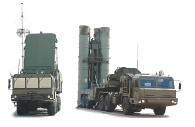
Αεροπορική Άμυνα: Η Ελλάδα στον τομέα αυτό διαθέτει τους αμερικανικούς Patriot και τους ρωσικούς S-300 PMU-1 και προγραμματίζει περαιτέρω την αναβάθμισή τους. Η Τουρκία έχει τους MIM-23 Hawk, MIM-14 Nike Hercules και έχει ενισχυθεί περαιτέρω με την αγορά των ρωσικών S-400.
ΑΜΥΝΤΙΚΕΣ ΔΑΠΑΝΕΣ
Ο τομέας της άμυνας συνεχίζει να απορροφά σημαντικούς εθνικούς πόρους στις δύο χώρες, δεδομένων και των οικονομικών τους προβλημάτων, για τα οποία αισθάνεται ιδιαίτερα βεβαρυμμένη η ελληνική πλευρά. Η Ελλάδα το 2025 διέθεσε για την άμυνα της 8 δισεκατομμύρια δολάρια και η Τουρκία περισσότερα από τα διπλάσια (21 δισεκατομμύρια δολάρια), κυρίως λόγω διαφορετικών απαιτήσεων και μεγεθών του Ακαθάριστου Εγχώριου Προϊόντος (ΑΕΠ). Τα υψηλότερα ποσά για την άμυνα στην Ευρώπη διαθέτουν η Γερμανία 107 δισεκατομμύρια δολάρια, το Ηνωμένο Βασίλειο 94 δισεκατομμύρια δολάρια, η Γαλλία 70 δισεκατομμύρια δολάρια και η Ιταλία 40 δισεκατομμύρια δολάρια.
Ωστόσο, για την Ελλάδα, η οποία αντιμετωπίζει ισχυρές προκλήσεις και απειλές από την Τουρκία, η θυσία στην οποία υπόκεινται από τη δεκαετία του 1970 έως πρόσφατα, όπως αυτή μετριέται ως ποσοστό που διατίθεται για την άμυνα από το ΑΠΕ, ήταν η μεγαλύτερη από κάθε άλλη ευρωπαϊκή χώρα. Η συμμετοχή της στον μηχανισμό SAFE της ΕΕ και ο άμεσος - όχι έμμεσος – αποκλεισμός της Τουρκίας της προσφέρουν οικονομικές διευκολύνσεις στον τομέα του στρατιωτικού εξοπλισμού.
Το 2025, ωστόσο, με έναν μέσο όρο αμυντικών δαπανών στην ΕΕ στο 1,95% επί του ΑΕΠ, η Ελλάδα διαθέτει το 2,86% και η Τουρκία το 1,37%. Τις υψηλότερες δαπάνες για την άμυνα επί του ΑΕΠ πραγματοποιούν η Εσθονία με 4,13%, η Λιθουανία με 3,97%, η Λετονία με 3,42%, η Πολωνία με 3,19% και η Νορβηγία με 3,18%, προβληματισμένες από τον πόλεμο στην Ουκρανία και τις άλλες γεωπολιτικές εξελίξεις και ανακατατάξεις στην περιοχή.
Η κατά κεφαλήν δαπάνη για την άμυνα στην Τουρκία είναι $135, σε σύγκριση με $470 στην Ελλάδα, ενώ ο μέσος όρος στην Ευρώπη είναι $413. Την υψηλότερη κατά κεφαλήν δαπάνη για την άμυνα έχει η Νορβηγία ($1.118), το Η.Β. ($936) και η Γαλλία ($811).
Βασικές ευρωπαϊκές χώρες με παραδοσιακά χαμηλά ποσοστά αμυντικών δαπανών, απειλούμενες από τα γεγονότα στην Ουκρανία, τις ανησυχητικές γεωπολιτικές εξελίξεις και τις πιέσεις Τραμπ, έδωσαν μεγαλύτερη βαρύτητα στην άμυνά τους και στην αύξηση των κονδυλίων για το σκοπό αυτό, ξεπερνώντας και την Ελλάδα, που μέχρι πρόσφατα κατείχε την πρώτη θέση στον τομέα αυτό.
Κύριες Πηγές
Τα στοιχεία είναι ποσοτικά και ποιοτικά και προέρχονται από έγκυρες, ανεξάρτητες και προσβάσιμες πηγές, όπως το IISS, το SIPRI, το OSCE, καθώς και από οργανισμούς όπως το ΝΑΤΟ και η CIA, περιλαμβανομένου και πληροφοριακού υλικού που κατέχει το Κυπριακό Κέντρο Στρατηγικών Μελετών.
09/07/2026
ENGLISH TEXT
ANNUAL REPORT OF THE CYPRUS CENTRE FOR STRATEGIC STUDIES
THE GREECE–TURKEY BALANCE
OF POWER 2026
AND MUTUAL CONVENTIONAL DETERRENCE
By Dr Aristos Aristotelous
GENERAL CONCLUSIONS – FINDINGS
In 2026, Greece possesses the strongest deterrent capability it has enjoyed in decades, although the strategic challenge arising from Turkey's numerical superiority has by no means disappeared.
The Hellenic Armed Forces are currently experiencing one of the strongest and most qualitatively advanced periods in their history since 1974. In comparison with Turkey, although the neighbouring country continues to enjoy numerical superiority, the qualitative advantages achieved by Greece in the Air Force and the Navy tilt the overall military balance in Greece's favour.
From a strategic perspective, the fear of incurring unacceptable costs acts as a powerful deterrent for both sides against resorting to war as a means of forcibly advancing their national objectives. This condition of deterrence in Greek–Turkish relations has important implications for Cyprus, which on its own cannot generate sufficient conventional deterrence against Turkey.
Cypriot deterrence, however, is significantly strengthened when Ankara is compelled to calculate that any military advance against the free areas of the Republic of Cyprus could trigger a broader Greek–Turkish conflict. The well-known assertion that "Cyprus lies too far away" may have military significance, yet strategically it weakens the credibility of Greece's extended deterrence against the Turkish threat to Cyprus.
This constitutes the central conclusion of the latest annual report, The Greece–Turkey Balance of Power 2026, presented and analysed by the Head of the Cyprus Centre for Strategic Studies (CCSS), Dr Aristos Aristotelous.
Dr Aristotelous points out that the erosion of all the elements that collectively constitute a credible deterrence strategy during July 1974 resulted in the collapse of deterrence vis-à-vis Turkey and opened the way for the Turkish invasion and the subsequent occupation of the northern part of the Republic of Cyprus.
Military Assessment
The principal military findings are as follows:
Both countries possess the capability to conduct large-scale initial offensive operations, while also maintaining the capacity to survive a first strike and undertake retaliatory or offensive actions. Nevertheless, the political, economic, and military costs of a wider conflict would be catastrophic and strategically disadvantageous for both sides, producing no clear strategic winner.
Land Forces. In terms of military personnel, main battle tanks, armoured vehicles and other major equipment, Turkey maintains numerical superiority. However, this superiority has gradually diminished compared with previous years. Consequently, the force ratios between the two countries across several categories have become narrower and more favourable to Greece than in the past.
The Navy. Turkey seeks to strengthen its naval capabilities in the future through the acquisition of two light aircraft carriers, with both their strengths and vulnerabilities. Nevertheless, the current balance remains relatively favourable for Greek defence, particularly with regard to major naval assets such as submarines (9 Greek versus 12 Turkish) and frigates (14 Greek versus 17 Turkish), which provide Greece with strong capabilities to counter any challenge in the Aegean Sea.
Although the remainder of the Hellenic Navy's fleet is numerically smaller than Turkey's, it nevertheless constitutes a highly capable force that cannot be ignored by the opposing side.
The Air Force. With 234 combat aircraft—59 fewer than Turkey—Greece maintains a force ratio of approximately 1.2 Turkish fighters for every Greek fighter aircraft. This ratio has improved significantly following the acquisition of the French Rafale fighter aircraft.
Turkey remains particularly concerned by the difficulties surrounding the modernization of its fighter fleet and its continued exclusion from the F-35 programme, especially in light of Greece's prospective acquisition of the aircraft. At the same time, despite the obstacles it faces, Turkey continues to pursue its indigenous fighter aircraft programme intended to replace its F-16 fleet.
An important advantage for Greece lies in the considerably higher proportion of professional personnel serving in its Armed Forces compared with Turkey. Additional strengths include the cohesion of its armed forces, a clear understanding of the nature and origin of the threat they face, and their high standard of education and training.
Greece's principal challenges include its continuing demographic decline, fiscal and economic constraints, its relatively limited size, the absence of strategic depth, and the demanding technological and operational requirements associated with defending its extensive eastern geographical area.
Turkey's principal advantages include its substantially larger population and armed forces, together with the depth of its domestic defence industry, which provides a high degree of self-sufficiency across numerous sectors and has transformed Turkey into a significant exporter of defence products, particularly its internationally sought-after unmanned aerial vehicles (UAVs).
Among Turkey's principal vulnerabilities—beyond its economic challenges and the multiple security pressures it faces both domestically and regionally—are the erosion of democratic institutions, the continuing purges and suppression of dissenting officials, its still fragile (albeit somewhat improved) relations with the United States, the European Union and several regional states, as well as its ongoing tensions with Israel.
At the same time, the military balance is increasingly shaped by the emergence of new forms of warfare, including unmanned systems, artificial intelligence, electronic warfare, cyber warfare, network-centric operations and space capabilities. The ability to integrate these technologies into military operational structures is becoming one of the decisive determinants of modern deterrent power.
Strategic Conclusion
Turkey continues to enjoy numerical superiority. Greece, however, now possesses a combination of qualitative military capabilities, advanced technology, professional expertise and operational effectiveness sufficient to maintain a strong deterrent posture and to render any attempt by Ankara to impose its objectives through military force highly uncertain and exceptionally risky.
The fundamental strategic question in Greek–Turkish relations is therefore not which side possesses greater numbers, but whether both possess the capability, determination and credibility to impose unacceptable costs upon the other. To the extent that this condition exists, it gives rise to a form of mutual conventional deterrence, thereby contributing to regional stability despite the persistence of unresolved political disputes.
The true strategic significance of the balance of power does not lie in the pursuit of absolute military superiority, but rather in preserving conditions of mutual deterrence that reduce incentives for the use of military force and strengthen stability within both the Greek–Turkish and the Cypriot security systems.
Ultimately, the strategic value of deterrence is not measured by the likelihood of war, but by its ability to prevent war. As long as the opposing side understands that any resort to military force will inevitably entail unacceptable costs, peace, stability and the security of both Greece and the Republic of Cyprus are reinforced.
Deterrence, however, is not an end in itself; it remains the most reliable means of preserving peace.
ANALYSIS – COMPARISON OF MILITARY DATA
The population of Greece stands at 10,424,536, representing a 3% decrease compared with 2020. Turkey's population stands at 84,625,585, an increase of 4% over the same period.
The active military personnel of the Hellenic Armed Forces amounts to 131,650, representing a reduction of 11,350 personnel compared with 2020. Turkey's active military strength remains unchanged at 355,200 personnel.
Turkey possesses the largest armed forces within NATO after the United States and, more broadly, the largest military force in Europe. It is followed by Poland with 218,000 personnel, France with 204,000, Germany with 185,000, Italy with 160,000, the United Kingdom with 141,000, and then Greece.
Poland recorded the largest increase in military personnel (31,000), while the United Kingdom experienced the largest reduction (12,000), followed by Greece.
Based on these figures, the present force ratio stands at approximately 2.6 Turkish soldiers for every Greek soldier, compared with 3.5:1 in 2014. Turkey's active military strength has declined somewhat, primarily owing to the reduction in the duration of compulsory military service and the increasing number of draft evaders.
According to official government statements, the number of draft evaders in Turkey exceeds 550,000, while Greece records approximately 37,700 draft evaders.
ARMY (LAND FORCES)
Personnel
The Hellenic Army numbers 93,500 personnel, while the Turkish Land Forces comprise 260,200 personnel, both remaining at approximately the same numerical levels as in 2021.
The force ratio in 2026 stands at 2.7 Turkish soldiers for every Greek soldier, compared with 4.6:1 in 2014.
Approximately 52% of personnel serving in the Hellenic Army are professional soldiers. In Turkey, the proportion is approximately 23%, while the remaining 77% are conscripts serving either twelve-month or eight-month terms, depending on their category of service.
Main Battle Tanks
Greece fields 1,385 main battle tanks, while Turkey possesses 2,381.
Despite reductions in both countries, the balance remains virtually unchanged. In 2026, as in 2014, there are approximately 1.7 Turkish tanks for every Greek tank.
The main battle tanks operated by both countries are primarily of German and American origin, many of which require extensive maintenance, modernization or eventual replacement.
Infantry Fighting Vehicles (IFVs)
Greece operates 169 Infantry Fighting Vehicles (IFVs), unchanged since 2021 but reduced from 242 in 2020.
Turkey maintains approximately 633 IFVs, a figure that has remained broadly stable.
Armoured Personnel Carriers (APCs)
Greece fields 2,157 Armoured Personnel Carriers (APCs), unchanged since 2021 but 417 fewer than in 2020.
Turkey continues to operate 3,636 APCs, with no significant change in numbers.
The force ratio in APCs is approximately 1.7 Turkish vehicles for every Greek vehicle.
General-Purpose Armoured Vehicles
Greece possesses 1,217 general-purpose armoured vehicles, while Turkey fields 1,450, producing an approximate ratio of 1:1.2.
Recoilless Weapon Systems
In 2026 Greece is assessed as possessing 4,033 recoilless weapon systems, an increase of 1,060 over previous years.
Turkey fields 3,869 such systems.
Artillery
Artillery capabilities remain broadly comparable to previous years for both countries.
Greece possesses approximately 3,512 artillery systems of various types, including artillery guns, multiple-launch rocket systems, towed artillery and other supporting weapons.
Turkey fields approximately 7,752 artillery systems.
Anti-Tank Weapons
Greece possesses approximately 1,153 anti-tank weapon systems, almost identical to the previous year.
Turkey fields approximately 1,414.
Army Transport Aircraft
The Hellenic Army operates 12 transport aircraft, six fewer than in previous years.
Turkey operates 8 transport aircraft and 45 training aircraft.
Army Helicopters
Greece possesses 203 helicopters of various types and operational roles.
Turkey fields 335 helicopters, unchanged from the previous year.
Unmanned Aerial Vehicles (UAVs)
The Hellenic Army currently operates six SAGEM Sperwer reconnaissance UAVs, an older-generation system.
Turkey possesses more than 73 Bayraktar UAVs of various configurations, capable of reconnaissance, surveillance, and precision strike missions against ground targets.
Air Defence
The Hellenic Army operates 1,341 ground-based air-defence systems, including towed systems.
Turkey fields approximately 1,494 air-defence systems.
NAVY
Personnel
The Hellenic Navy has a strength of 16,350 personnel, representing an increase of 350 personnel compared with 2021. The Turkish Navy numbers approximately 45,000 personnel.
It is noteworthy that the overwhelming majority of personnel serving in the Hellenic Navy are professional servicemen and women, whereas in Turkey only about 30% of naval personnel are professionals. This difference may also be reflected in their respective levels of operational effectiveness.
Fleet
Submarines
The Hellenic Navy operates nine submarines, while the Turkish Navy fields twelve.
The submarine fleets of both countries are predominantly of German origin, with most belonging to older classes. Greece has modernised its Type 214 submarines, while Turkey has introduced its first state-of-the-art Type 214 Air Independent Propulsion (AIP) submarine, TCG Piri Reis, with additional vessels of the same class expected to follow.
Frigates
The Hellenic Navy operates 14 frigates, comprising the FDI HN (Belharra), the Dutch Kortenaer-class, and the German MEKO 200-class.
Turkey operates 17 frigates, including German MEKO 200 variants and the American Oliver Hazard Perry-class.
The introduction of enhanced area air-defence capabilities together with the planned integration of Naval SCALP cruise missiles, providing strategic strike capability, further strengthens the operational effectiveness and deterrent value of the Hellenic Navy.
Patrol Vessels, Amphibious Ships, Support Vessels, and Other Naval Assets
The Hellenic Navy operates:
- 33 patrol vessels
- 16 landing craft (carried by five amphibious ships)
- 36 support vessels of various types.
Turkey operates:
- 10 Corvettes
- 45 patrol vessels
- 35 landing craft (also carried by five amphibious ships)
- 35 support vessels of various categories.
Although Turkey enjoys numerical superiority in several categories, the Hellenic Navy continues to maintain a capable and balanced fleet with significant operational effectiveness in the Aegean and Eastern Mediterranean.
Naval Aviation
Greece operates five P-3 Orion maritime patrol and anti-submarine warfare aircraft, four of which are currently undergoing modernization.
Turkey operates 17 naval aircraft, comprising 10 maritime patrol aircraft and seven light transport aircraft.
In addition, Greece operates 20 naval helicopters, including 18 anti-submarine warfare helicopters and two multi-role helicopters.
Turkey operates 29 naval helicopters.
Unmanned Aerial Vehicles (UAVs)
The Turkish Navy currently operates three ANKA-S and four Bayraktar TB2 unmanned aerial systems capable of conducting strategic and tactical intelligence, surveillance, reconnaissance (ISR), and precision strike missions.
Turkey also plans to reinforce its naval aviation further through the introduction of the Bayraktar TB3, intended to operate from naval platforms as part of the implementation of its "Blue Homeland" (Mavi Vatan) maritime doctrine.
AIR FORCE
Personnel
The Hellenic Air Force comprises approximately 21,800 personnel.
The Turkish Air Force numbers approximately 50,000 personnel, representing a reduction of around 10,000 from 2014.
Fighter Aircraft
The Hellenic Air Force operates 234 combat aircraft, compared with 262 in 2020. These include newly acquired French Rafale fighters together with upgraded American-built fighter aircraft.
Turkey currently fields 293 combat aircraft, compared with 352 in 2020.
Turkey's removal from the F-35 Joint Strike Fighter Programme has significantly affected the modernization of its air combat capability. Meanwhile, Greece's prospective acquisition of the F-35 is expected to widen the qualitative gap between the two air forces.
Reconnaissance Aircraft
Greece operates eight reconnaissance aircraft, while Turkey fields thirty-eight.
Airborne Early Warning and Control (AEW&C)
Both countries operate four airborne early warning aircraft.
Greece operates the EMB-145 AEW&C, while Turkey operates the Boeing 737 AEW&C (Peace Eagle) platform.
Transport Aircraft and Helicopters
Greece operates:
- 23 transport aircraft, including C-160 Transall, C-130 Hercules and C-27 Spartan, together with three light transport aircraft.
- 31 light and medium helicopters.
Turkey operates:
- 89 transport aircraft, including C-27, Hercules and Spartan platforms.
- 35 helicopters.
Unmanned Aerial Vehicles (UAVs)
Turkey enjoys overwhelming numerical superiority in unmanned aerial systems, operating approximately 140 UAVs, compared with Greece's 10.
This constitutes one of the most significant quantitative advantages enjoyed by the Turkish Air Force.
Air-to-Air Refueling Aircraft
The Turkish Air Force operates seven aerial refueling aircraft, providing it with considerably greater operational reach and endurance.
Greece currently possesses no air-to-air refueling capability.
Air Defence
Greece's integrated air-defence system includes the U.S.-made Patriot missile system together with the Russian S-300 PMU-1, both of which are scheduled for further modernization.
Turkey operates the MIM-23 Hawk and MIM-14 Nike Hercules systems and has further strengthened its strategic air-defence capabilities through the acquisition of the Russian S-400 system, which seems not to have been deployed yet.
DEFENCE EXPENDITURE
Defence continues to absorb substantial national resources in both Greece and Turkey despite the economic challenges facing both countries, challenges that weigh particularly heavily on the Greek economy.
In 2025, Greece allocated approximately US$8 billion to defence, while Turkey spent more than US$21 billion, over twice as much. This difference largely reflects the differing sizes of the two economies and the corresponding requirements arising from their Gross Domestic Product (GDP).
Within Europe, the highest defence expenditures were recorded by:
- Germany: US$107 billion
- United Kingdom: US$94 billion
- France: US$70 billion
- Italy: US$40 billion
For Greece, however, which continues to confront persistent security challenges and threats from Turkey, the national sacrifice devoted to defence—measured as a percentage of GDP—from the 1970s until very recently has been greater than that of any other European country.
Greece's participation in the European Union's SAFE mechanism, together with Turkey's direct—rather than indirect—exclusion from the program, provides Greece with important financial advantages in procuring military equipment.
In 2025, while the average defence expenditure among EU Member States amounted to 1.95% of GDP, Greece allocated 2.86%, whereas Turkey allocated 1.37%.
The countries allocating the highest percentage of GDP to defence were:
- Estonia: 4.13%
- Lithuania: 3.97%
- Latvia: 3.42%
- Poland: 3.19%
- Norway: 3.18%
These increases largely reflect growing concerns over the war in Ukraine, as well as broader geopolitical developments and shifts in Europe's security environment.
Per capita defence expenditure in Turkey is approximately US$135, compared with US$470 in Greece, while the European average is US$413.
The countries with the highest per capita defence expenditure are:
- Norway: US$1,118
- United Kingdom: US$936
- France: US$811
Several major European countries that traditionally maintained relatively low levels of defence spending have significantly increased their defence budgets in response to the war in Ukraine, the deteriorating geopolitical environment, and pressure from the United States under President Donald Trump.
As a result, a number of these countries have now overtaken Greece in defence expenditure as a percentage of GDP, despite Greece having ranked first in this category until very recently.
PRINCIPAL SOURCES
The data presented in this report are both quantitative and qualitative in nature and have been compiled from reliable, independent, and publicly accessible sources, including: International Institute for Strategic Studies (IISS), Stockholm International Peace Research Institute (SIPRI), Organization for Security and Co-operation in Europe (OSCE), North Atlantic Treaty Organization (NATO), and the Central Intelligence Agency (CIA). The analysis also incorporates information and research material held by the Cyprus Centre for Strategic Studies (CCSS).
Concluding Observation
The 2026 Greece–Turkey Balance of Power Report demonstrates that although Turkey continues to enjoy a significant numerical advantage in several conventional military categories, Greece has substantially strengthened the qualitative dimensions of its military power through modernization, technological advancement, professionalization and operational readiness.
The report concludes that the decisive strategic issue is no longer numerical superiority alone but the ability of each side to impose unacceptable costs on the other. In this sense, the evolving military balance has created conditions conducive to mutual conventional deterrence, reducing incentives for military confrontation while contributing to strategic stability in the Aegean, the Eastern Mediterranean, and Cyprus.
For the Republic of Cyprus, this finding is of particular strategic significance. While Cyprus cannot independently establish a sufficient conventional deterrent against Turkey, its security is enhanced by the credibility of Greece's extended deterrence and by Ankara's assessment that any military escalation against Cyprus could trigger a broader Greek–Turkish conflict.
Accordingly, the report argues that the preservation of credible deterrence remains the most reliable guarantee of peace, stability and security for both Greece and the Republic of Cyprus.
09/07/2026